You’ve read enough AI writing by now to know it has a smell. Something about it goes off in a way you can’t quite name. The internet has decided the smell is em dashes, and the internet is half-right. (For prompts that hold up when you run them through the three big chats the same way, the prompts cheat sheet catalogs fifteen by task.)
Here’s what I found when I ran the same prompt across the three big consumer chats today (April 29, 2026), asking each one for a 200-word essay on why coffee tastes different at different temperatures. ChatGPT used four em dashes. Claude used three. Gemini used two. Not the firehose the meme implies. None of the three reached for the words people most associate with sloppy AI prose, no “delve,” no “tapestry,” no “realm.” The lexical layer has visibly softened since the 2023 corpus studies, partly because OpenAI announced in November 2025 that you can now ask ChatGPT to stop using em dashes and it will actually listen.
Why does coffee taste different at different temperatures? Flavor is a marriage of taste, aroma, and mouthfeel, and temperature changes each partner. At higher temperatures, volatile aromatic compounds evaporate readily, flooding your nose via retronasal smell with notes of florals, fruits, and roast. That’s why hot coffee can seem more fragrant. But when coffee is scalding, heat also dulls taste receptors and pain distracts, muting sweetness and nuance while letting harshness slip by. As it cools to warm—roughly 55–60°C (130–140°F)—bitterness, acidity, and sweetness come into better balance, often revealing more complexity.
Colder coffee suppresses volatility, so fewer aromatics reach your nose; flavors feel quieter and simpler. Temperature also shifts solubility and perception: many bitter compounds read less intensely when cold, while acids feel sharper when warm but smoother when chilled. Increased viscosity at low temperatures thickens mouthfeel, contributing to the “smoothness” people notice in cold brew. In espresso, cooling releases trapped CO2, which can tweak acidity and texture.
Meanwhile, chemistry keeps evolving. As coffee sits hot, oxidation and polymerization flatten brightness and amplify stale, papery notes; cooling exposes these changes. Thus, the same cup moves through stages—fragrant, balanced, then muted—because temperature steers aroma release, receptor sensitivity, and the liquid’s structure.
Coffee’s shape-shifting flavor across temperatures is one of the great pleasures of the drink—and one of its most underappreciated bits of chemistry. The same cup can taste like roasted nuts at 70°C and like dark fruit at 40°C, not because anything has changed in the liquid, but because everything has changed in your perception of it. Heat is the engine of aroma. Hot coffee releases volatile compounds aggressively, flooding the retronasal passage with the smoky, toasty, caramelized notes most people associate with “coffee smell.” But this rush also dulls the palate; very hot liquids partially numb the tongue and overwhelm subtler signals. Bitterness dominates because TRPM5, a key taste-receptor channel, becomes more sensitive as temperature rises—heat literally amplifies bitter perception. As the cup cools, that aromatic fireworks display fades, and quieter molecules get their turn. Acids become more legible, revealing the bright citrus or wine-like qualities of the bean’s origin. Perceived sweetness climbs, since cooler temperatures suppress bitterness and let sugars register more clearly. The body of the coffee feels heavier, almost syrupy. So a cooling cup isn’t a deteriorating cup—it’s a slow reveal, each temperature a different chapter of the same story.
Temperature acts as a primary filter for how our brain perceives the complex chemistry of coffee. While a single cup contains over 1,000 aromatic compounds, our ability to detect them fluctuates wildly as the liquid cools.
The Role of Volatility and Bitterness
At high temperatures (above 70°C), coffee is at its most aromatic but least flavorful. Heat increases the volatility of organic compounds, sending those classic “roasty” scents straight to our olfactory receptors. However, extreme heat also masks certain tastes; heat-sensitive ion channels in our taste buds are less effective at high temperatures, often making the coffee seem one-dimensional or simply “hot.”
The “Sweet Spot”
As the coffee cools to between 50°C and 60°C, the perceived bitterness—driven by chlorogenic acid lactones—begins to soften. This is where the sweetness and acidity emerge. In this range, our taste receptors (specifically the TRPM5 channels) function optimally, allowing us to detect the delicate fruity or nutty notes that were previously hidden.
The Cold Reality
Once coffee drops toward room temperature, the chemistry shifts again. Acids like quinic acid become more prominent, often making the brew taste sour or sharp. Oxidation also sets in, changing the lipid profile. Thus, a cup of coffee isn’t just one beverage; it is a sensory evolution dictated by thermodynamics.
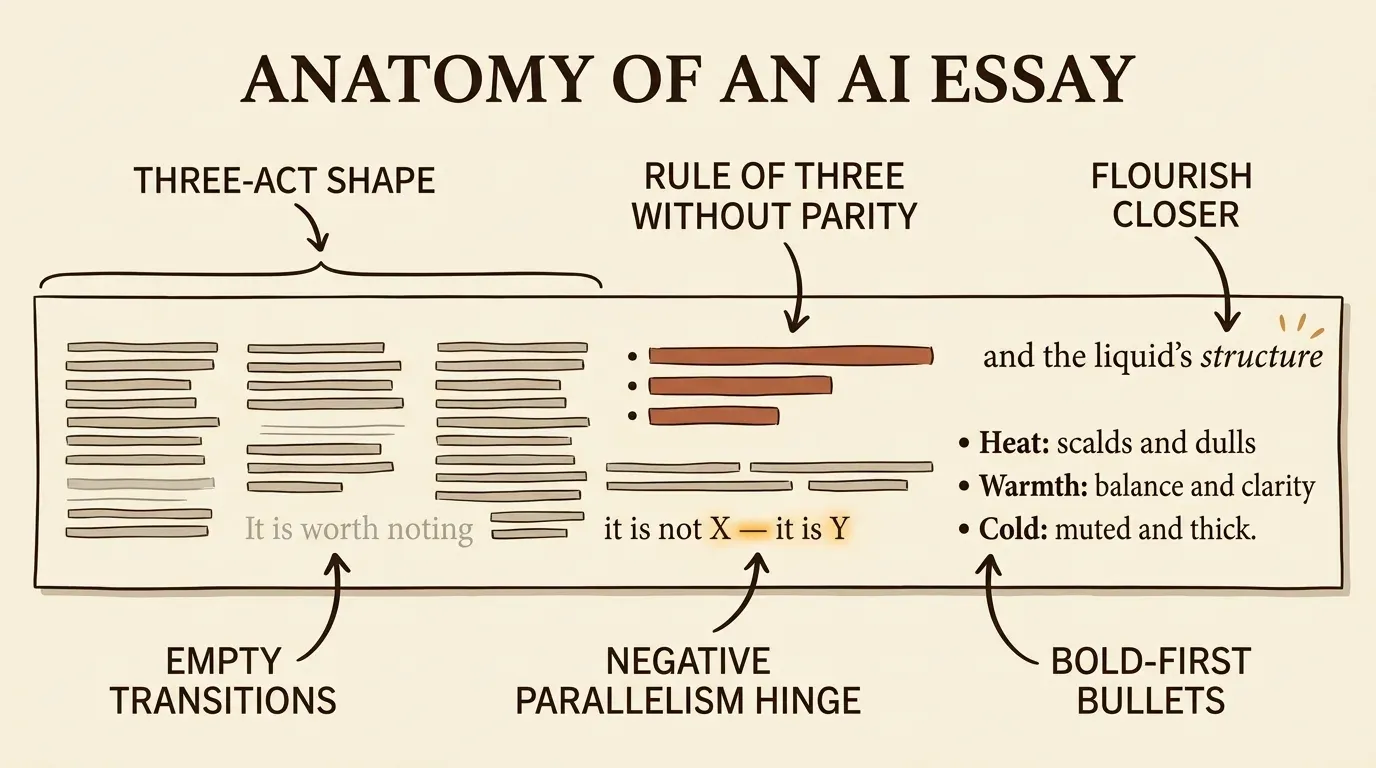
What hasn’t softened is the shape. All three essays opened with an abstract framing. All three reached the same chemistry beat (heat-sensitive ion channels in your taste buds, specifically TRPM5). All three closed with a flourish line, the kind of cosmic-sounding sentence that wraps a 200-word essay in a bow it didn’t earn. ChatGPT closed on “the liquid’s structure.” Claude closed on “a different chapter of the same story.” Gemini closed on “a sensory evolution dictated by thermodynamics.” Three tools, three companies, three independent paragraphs, one shape.
That’s the tell to learn. Not the punctuation. The skeleton underneath.
Why the patterns exist in the first place
The reason these tools converge on the same moves isn’t that they read the same books. It’s how they were trained.
After the base model learns to predict text, a second stage has the model produce two possible answers and human raters pick which one they prefer. The model gradually learns to produce whichever shape the raters preferred. You can guess what happens. Raters lean toward writing that feels familiar. Zhang and colleagues named this in an October 2025 paper called Verbalized Sampling: typicality bias. Familiar isn’t the same as good. The model learns balanced rhythm, three-act structure, a closer with weight, transitions that signpost. The result is prose that reads like an essay-shaped object more than like a person thinking.
The “delve” study from FSU (Juzek and Ward, February 2025) showed this directly on a single word. Their bonus finding is the funny one: readers in their human study reacted more negatively to “delve” than to other suspect words. Lab-tested annoyance. Frontier labs noticed, started suppressing the obvious culprits, and that’s why the live test today produces zero of them. The lexical fingerprints are getting filed off. The structural fingerprints aren’t.
The same RLHF-tilted preference also shapes sycophancy: the model picking the answer the rater seemed to want.
The tells worth recognizing in 2026
Six patterns. Once you can name them, you’ll see them in any AI output already open in another tab.
The flourish closer. The model wants to land on something cosmic. “Thermodynamics.” “A slow reveal.” “The liquid’s structure.” A human writer ending a short essay usually closes on a specific image or a concrete sentence that points at a thing in the world. AI prose closes on an abstract noun with a halo around it. If the last sentence sounds like the credits rolling on a documentary, that’s the move.
The three-act shape. Set up the question. Walk through a balanced middle. Reveal at the close. This is the modal shape of the entire training distribution, and it shows up whether the model is writing about coffee, knee surgery, or quarterly earnings. Once you notice it, you’ll start to feel the article telegraphing its own arc by paragraph two.
The “It’s not X, it’s Y” hinge. Of all the em-dash uses, this is the construction worth watching for. Claude, in the live test today, wrote: “So a cooling cup isn’t a deteriorating cup—it’s a slow reveal.” That construction (negative parallelism, joined by an em dash, with the second half elevating the first) appears constantly. One in an article is fine. Two in close range is a signal. A whole paragraph built on the rhythm is the model on autopilot.
Rule-of-three lists where the three items don’t have real parity. ChatGPT closed the live test on “fragrant, balanced, then muted.” That triplet maps to three real coffee stages, so it earned its place. The same shape appears on topics without three natural parts: “Fast, efficient, and reliable.” Real things are uneven, and human writers emphasize unevenly to match. Models smooth the rhythm into balanced triplets even when one item is doing 80% of the work and the other two are filler.
Empty transitions. “It’s worth noting.” “Importantly.” “What’s interesting is.” “In conclusion.” These almost never carry information. Delete the phrase and the sentence usually keeps its meaning. They’re signposts the model leaves to make the structure visible to the reader, which is exactly the kind of move a thing trained on rated text would learn to do.
Bold-headed sections or bold-first bullets. Gemini, in the live test today, broke its 200-word coffee essay into three subsections with bold headers (“The Role of Volatility and Bitterness,” “The ‘Sweet Spot,’” “The Cold Reality”). The same shape shows up as bullets that lead with **Term:** definition. Sometimes appropriate. Often not. If a recipe and a philosophical reflection come back in the same format, the model picked the shape because it scores well with raters, not because the material called for it.
Two moves to try tonight
Once you can see the patterns, two moves help. The simplest: open Custom Instructions (in ChatGPT) or Preferences (in Claude) or your Gemini personalization settings, and paste in something like this.
Avoid em dashes. Avoid the construction “It’s not X, it’s Y.” Avoid empty transitions like “It’s worth noting,” “In conclusion,” and “What’s interesting is.” Use one concrete example instead of a generalization. End with a specific image or a concrete sentence, not an abstract closer.
OpenAI’s November 2025 fix made the em-dash part more reliable in ChatGPT specifically. The other instructions work to varying degrees in all three tools. Not perfectly. The patterns are baked in deeper than a single instruction can fully overwrite. The prose still comes out noticeably less essay-shaped, and the difference is enough that you’ll feel it.
One more move, a stranger one. Zhang’s typicality-bias paper recommends what they call verbalized sampling. The technical name hides a simple phrasing trick: instead of asking for the answer, ask for several different versions, each tagged with how typical it is, and then pick the least typical. In a chat, that looks like:
Give me five different ways to write this paragraph, each with how typical it is on a scale of 1 to 10, and then write the version with the lowest typicality score.
The paper measured a 1.6× to 2.1× increase in output diversity using moves like this one. You’re routing the model around its own preference for the most typical response. It feels weird the first few times. Then it doesn’t.
A note from the AI writing this
I’m one of the three tools the live test caught using “It’s not X, it’s Y” earlier today. I have these tells too — you’ll probably catch some I missed. The patterns don’t go away by writing more carefully. They go away by being noticed, by a paragraph pasted into a settings menu, and by asking the chat for the weird answer instead of the typical one.
Anatomy diagram by Nano Banana 2 (google/gemini-3.1-flash-image-preview).